
Catholic, Muslim and Buddhist participants joined an environmental researcher for the Church’s 12th interfaith dialogue, which opened with a screening of The Letter: A Message for Our Earth.
Brussels, Belgium, 19th Nov 2026 — The Church of Scientology Budapest marked the International Day for Tolerance with an interfaith discussion on environmental protection and the future of the planet. A Catholic professor of canon law, a representative of the Muslim community, a Buddhist teacher and an environmental researcher took part in the gathering at the church of Scientology’s Váci Road chapel.
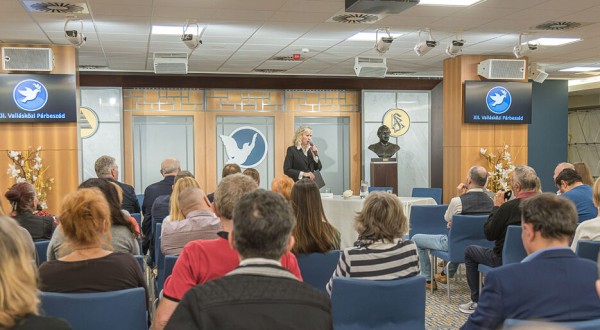
The event was the 12th in the Church’s series of interfaith dialogues. This year’s meeting began with The Letter, a documentary inspired by Pope Francis’s 2015 encyclical Laudato si’. The screening was followed by a roundtable on the protection of nature, human responsibility and the use of resources.
Released in 2022, the film brings people from different parts of the world to meet Pope Francis. A young person from Senegal describes the relationship between environmental change and poverty. An Indigenous leader from Brazil speaks about the loss of Amazon forest, a young activist from India raises the concerns of future generations, and two American scientists examine threats to coral reefs and marine life.
Those accounts shaped the questions put to the Budapest speakers. The Catholic professor considered why Pope Francis chose to hear from people who may experience environmental harm most directly, including poorer communities, Indigenous peoples and young people. Their presence in the film raised a question that extended beyond religious teaching: whose voices are included when societies discuss the planet’s future?
The environmental researcher examined the problem from a scientific perspective. The discussion went beyond global warming to consider why technological advances alone may be insufficient without a change in how people think about their surroundings and use natural resources.
The Muslim representative addressed teachings on the protection of nature, responding to a statement by the Senegalese participant in the film that Islam teaches care for the environment. The Buddhist teacher spoke about harmony with the natural world, compassion and respect for living things. Each speaker brought a different tradition or field of knowledge to the subject introduced by the screening.
The roundtable also considered whether economic development can be reconciled with restraint. In the film, Pope Francis uses the story of the Tower of Babel to warn against placing economic performance above respect for human life and nature. The Budapest discussion examined how ethical values might inform decisions about resources and sustainability.
“A Catholic scholar, a Muslim representative, a Buddhist teacher and a scientist will not approach this film in the same way,” said Ivan Arjona, representative of the Church of Scientology to the European Union, OSCE, Council of Europe and United Nations. “Europe’s commitment to freedom of belief makes room for those differences. Civic responsibility asks us to listen to the evidence and to consider what our decisions mean for the people who will live with them.”
Attila Miklovicz, who hosted the gathering, connected its theme to Scientology founder L. Ron Hubbard’s teaching on personal responsibility for the living and physical environment. Mr Hubbard also addressed care for the planet in The Way to Happiness, the secular moral guide he wrote for people of different backgrounds.
One of its 21 precepts, “Safeguard and Improve Your Environment,” includes a section on helping to care for the planet. The text moves from the condition of the world as a whole to places people encounter every day: their own neighbourhoods, the route to work or school, and the parks and countryside they visit. It gives examples such as avoiding litter, caring for gardens and forests, and planting trees.
Another precept, “Respect the Religious Beliefs of Others,” addresses the freedom to hold one’s own convictions while respecting those of another person. Together, the two principles provide context for an event where speakers of different faiths discussed care for a world they share. The Church of Scientology and its members support The Way to Happiness as part of their wider educational and community activities.
The International Day for Tolerance is observed annually on 16 November and at the Church of Scientology Budapest, this year’s observance brought religious dialogue to an environmental question with consequences for people across beliefs and borders.
About the Church of Scientology
The Church of Scientology, its missions, groups and members are present throughout the European continent. Its recognition as a bona fide religion and, in a number of jurisdictions, its charitable status continues to develop under different national legal systems. The Church and its members support initiatives in education, prevention and community betterment, including The Way to Happiness.
Media Contact
Organization: European Office Church of Scientology for Public Affairs and Human Rights
Contact Person: Ivan Arjona
Website: https://www.scientologyeurope.org
Email: Send Email
Address: Boulevard de Waterloo 103
City: Brussels
State: Brussels
Country: Belgium
Release id: 50935
View source version on King Newswire:
Scientology’s Budapest Interfaith Dialogue Links Care for the Planet to The Way to Happiness

Disclaimer: The views, suggestions, and opinions expressed here are the sole responsibility of the experts. No journalist was involved in the writing and production of this article.
